
Apricot Kernel Shell Green Energy & Industrial Solution
Globally demanded organic raw material combining 4,800 kcal/kg high heat value, 3.5 Mohs precision sandblasting hardness, and a zero-waste circular economy framework.
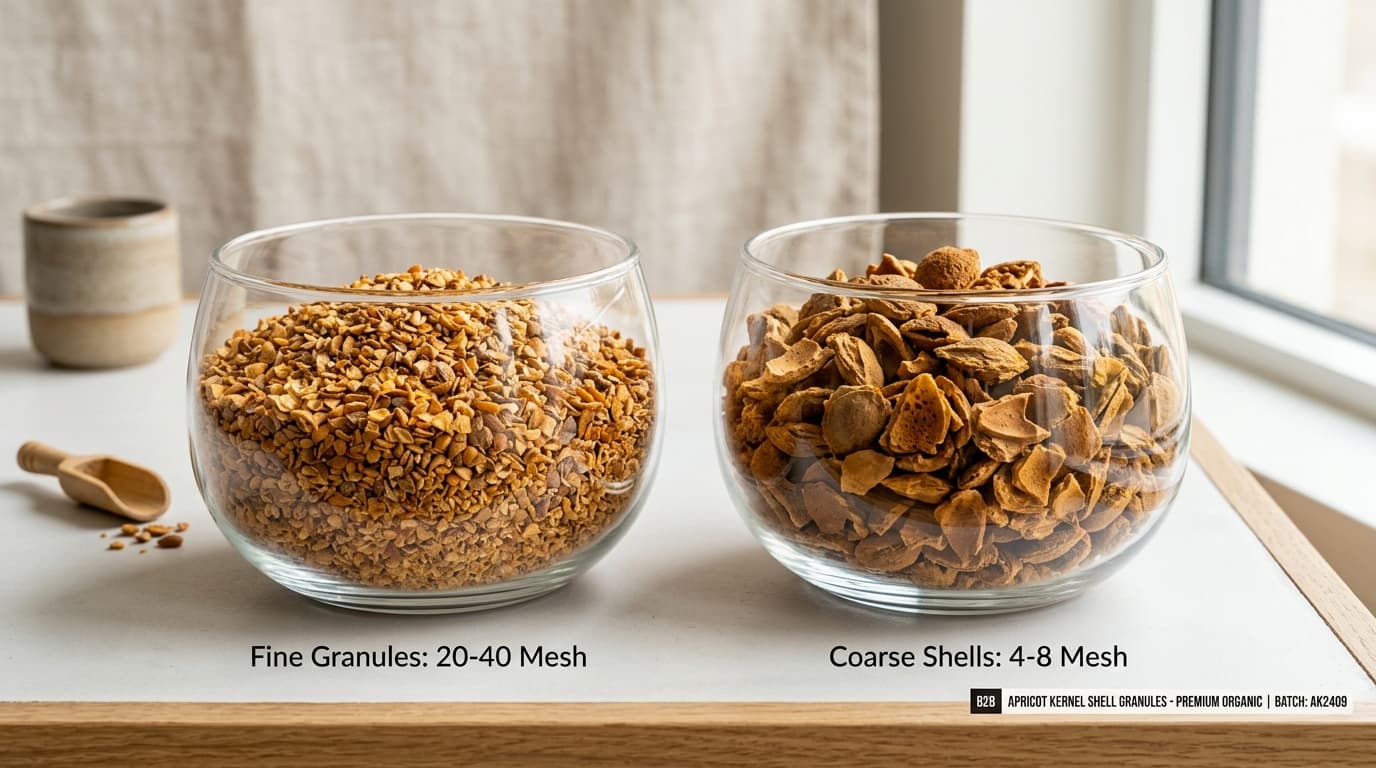
Nature's Powerful & Versatile Industrial Resource
Apricot kernel shell is the hard, organic, lignocellulosic outer shell obtained during the kernel cracking process of Malatya's world-renowned apricots. Once considered a simple regional heating fuel, modern crushing, dust-extraction, and optical sieving technologies have transformed it into a high-value industrial raw material across global markets.
With ultra-low ash (<1.5%), low moisture (<9%), and virtually zero sulfur emissions, it complies fully with EU Green Deal standards as a clean biomass solid fuel. It is also globally recognized as an eco-friendly non-destructive blasting abrasive and a 100% natural, microplastic-free cosmetic exfoliant.
At Apricot Kernels, we process and grade shells into precise micron and millimeter fractions (from 0.2 mm to 10 mm) at our state-of-the-art Malatya facility, exporting in bulk to over 50 countries.
Clean Combustion
Sulfur-free & ultra low ash with no clinker
3.5 Mohs Hardness
Non-destructive soft blasting on delicate alloys
Circular Economy
100% organic, biodegradable zero-waste
Superior Performance Across 5 Key Sectors
Targeted solutions powered by the shell's high mechanical resistance and rich carbon matrix
Biomass Solid Fuel & Green Energy
With 4,500 - 4,850 kcal/kg net calorific value, it exceeds lignite coal in thermal output. Low ash content (<1.5%) prevents boiler slagging, while zero sulfur content lowers flue gas filtration overheads. Ideal for industrial boilers, greenhouses, and briquette manufacturing.
Industrial Sandblasting & Surface Cleaning
Classified as a soft organic abrasive at 3.0 - 3.5 Mohs. Effectively removes rust, old paint, carbon deposits, and flash from aircraft fuselages, turbine blades, aluminum/brass molds, and historic stone without etching or altering dimensional tolerances.
Activated Carbon & Filtration Media
Rich in fixed carbon and dense microporosity, it serves as the premier raw material for manufacturing high-surface-area activated carbon used in gold extraction, drinking water purification, and industrial air filtration.
Cosmetic Exfoliant & Scrub Particles
Sterilized and finely ground fractions (0.2 - 0.8 mm / 20-60 mesh) provide a 100% biodegradable, sustainable replacement for banned polyethylene microbeads in facial scrubs, body washes, and artisan soaps.
Agricultural Mulch & Soil Conditioner
Acts as a protective organic mulch in landscaping and orchards, locking in soil moisture, suppressing weed growth, and gradually decomposing into organic soil humus.
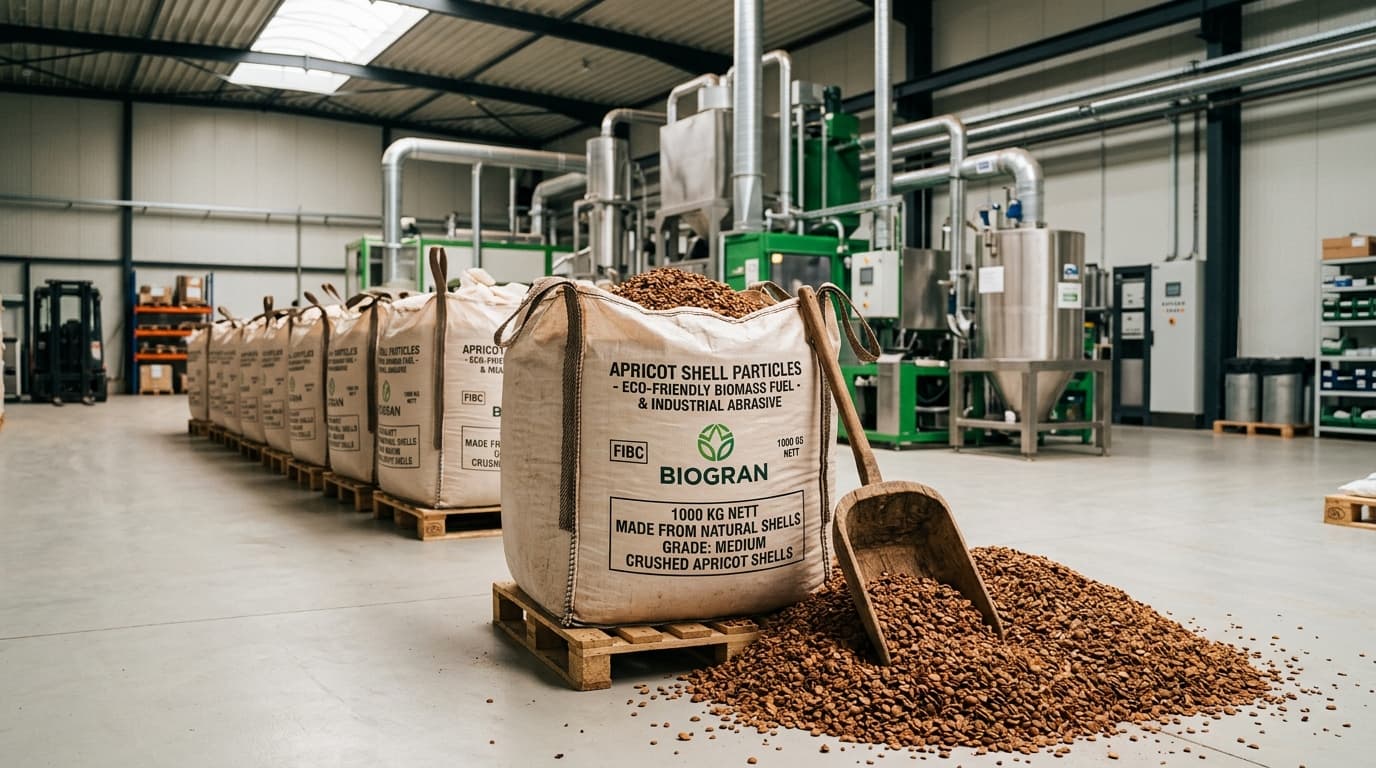
1,000 kg Big Bags & Bulk Liner
Reliable worldwide freight to over 50 countries
Product DetailsStandard Sieve Sizes and Classification
Carefully screened, dust-extracted fractions tailored to specific industrial requirements
| Fraction / Size | Mesh Size | Recommended Application | Quality Grade |
|---|---|---|---|
| 0.2 - 0.5 mm | 35 - 70 Mesh | Facial Scrubs, Cosmetic Grade Particles, Ultra-Fine Abrasive | Micro-Fine (Cosmetic Grade) |
| 0.5 - 1.0 mm | 18 - 35 Mesh | Body Scrubs, Precision Blasting on Delicate Alloys & Electronics | Fine Grade |
| 1.0 - 2.0 mm | 10 - 18 Mesh | Industrial Sandblasting, Turbine & Mold Cleaning, Activated Carbon | Medium Grade |
| 2.0 - 4.0 mm | 5 - 10 Mesh | Heavy Sandblasting, Water Filtration Bedding, Activated Carbon | Coarse Grade |
| 4.0 - 8.0 mm | 2.5 - 5 Mesh | Biomass Solid Fuel, Industrial Boilers, Landscape Mulch | Biomass Fuel Grade |
| Whole Shells | Natural Size | Bulk Biomass Energy Plants, Industrial Boilers, Briquette Raw Material | Raw Whole Shells |
Technical Analysis & Chemical Specifications
Consistent quality parameters verified by accredited laboratory test reports for every batch
Significantly higher heat yield than wood pellets and raw lignite
Low moisture ensures long-term shelf stability without fermentation
Minimal clinker and residue for clean, uninterrupted combustion
Gentle soft abrasive that preserves substrate dimensional integrity
High volumetric density optimizing container storage and freight costs
Near-zero SOx emissions, clean burning with no acid-rain precursors
Rapid ignition and stable flame propagation
High carbonization yield for activated carbon production
Apricot Kernel Shell vs Alternative Materials
Environmental and economic superiority over fossil fuels and synthetic abrasives
| Material Type | Hardness / Heat Output | Surface / Emission Impact | Health & Ecology | Reusability & Cost |
|---|---|---|---|---|
| Apricot Kernel ShellBest | 3.5 Mohs / 4,800 kcal | Non-destructive surface cleaning & Clean combustion | 100% Natural, Non-Toxic, Zero Sulfur | High Efficiency (4-6x Reusable in Blasting) |
| Walnut Shell | 3.0 Mohs / 4,500 kcal | Soft blasting, good heat yield | Organic, potential nut allergen concerns | High |
| Silica Sand (Quartz) | 7.0 Mohs / Not Fuel | Severely etches metal and damages surface profile | Hazardous (Silicosis respiratory disease risk) | Low purchase price but single-use only |
| Lignite Coal | Fuel / 3,000 - 3,800 kcal | Heavy clinker and thick soot emissions | High SO2, heavy metals, and high carbon footprint | Subject to high carbon taxes and filter costs |
Zero Waste, Decarbonized Future
Valuing every single part of the apricot harvest to protect our planet
Zero-Waste Philosophy
Apricot fruit is sun-dried for food, the inner kernel provides oil and protein, and the outer shell supplies green energy and industrial media. Zero waste.
Carbon Neutral Cycle
The carbon released during shell combustion equals the carbon sequestered by the apricot trees during growth, ensuring a closed biogenic carbon loop.
Eliminating Microplastics
Providing cosmetic formulators with 100% biodegradable natural scrub particles to replace polluting synthetic microbeads.
International Shipping Standards
Delivering worldwide with moisture-protected, heavy-duty export packaging
1,000 kg Big Bag (FIBC)
4-loop heavy-duty woven polypropylene bulk bags with discharge spout, ideal for forklift handling.
25 kg / 40 kg Bags
Palletized, shrink-wrapped, and stretch-hooded PP or Kraft multi-wall sacks for manual handling.
Bulk Silo Truck / Container Liner
Direct container liner or bulk silo truck discharge for high-volume industrial and power facilities.
Everything You Need to Know About Apricot Shells
Expert answers on wholesale procurement, technical specs, and industrial applications
Q.What is the net calorific heat value of apricot kernel shell?
Apricot kernel shell yields an average net calorific value of 4,500 - 4,850 kcal/kg (18.8 - 20.3 MJ/kg). This is notably higher than standard wood pellets (4,000-4,300 kcal/kg) and typical lignite coal (2,500-3,500 kcal/kg).
Q.Why is apricot shell preferred for sandblasting over traditional grit?
With a hardness of 3.0 - 3.5 Mohs, apricot shell is a soft organic abrasive. It effectively strips paint, rust, scale, and carbon deposits from delicate alloys, aircraft parts, turbine blades, and automotive molds without micro-scratching or altering critical dimensional tolerances.
Q.Which sieve fractions are recommended for cosmetics and personal care?
For gentle facial exfoliants, 0.2 - 0.5 mm (35-70 mesh) is widely used, while 0.5 - 1.0 mm (18-35 mesh) is ideal for body scrubs, foot exfoliants, and exfoliating soaps. All cosmetic grades are microbially tested and sterilized.
Q.What is the Minimum Order Quantity (MOQ) and shipping terms?
Our standard MOQ for wholesale B2B exports is 1 full truckload (24 Metric Tons) or one 20ft/40ft FCL container. We export under FOB Mersin/Izmir, CIF, CFR, and EXW terms to over 50 countries.
Q.Does burning apricot shells damage industrial boilers or produce harmful emissions?
No. Apricot kernel shell has a very low sulfur content (<0.02%), preventing acid gas formation. Its low ash content (<1.5%) prevents sticky clinker formation on boiler tubes, ensuring clean, continuous combustion.
Q.Why are apricot shells an optimal precursor for activated carbon?
The shell features a dense lignocellulosic structure and high fixed carbon (>50%). After carbonization and activation, it develops an extensive micropore volume and high iodine adsorption number, making it superior for gold recovery, drinking water filtration, and gas purification.
Q.Can apricot shell blasting media be recycled and reused?
Yes. Due to its resilient organic structure, apricot shell abrasive can typically be recycled through closed-loop blast cabinets 4 to 6 times before breaking down, significantly lowering media consumption costs.
Q.Do you provide Certificate of Analysis (CoA) and product samples?
Yes. Every batch is accompanied by an accredited Certificate of Analysis (CoA) detailing Calorific Value, Moisture, Ash, Sulfur, and Sieve Distribution. We supply laboratory test samples to corporate B2B clients upon request.
Request a Wholesale Quote for Apricot Kernel Shells
Direct-from-origin competitive pricing, customizable sieve sizing, and reliable global freight for biomass energy and industrial abrasive buyers.